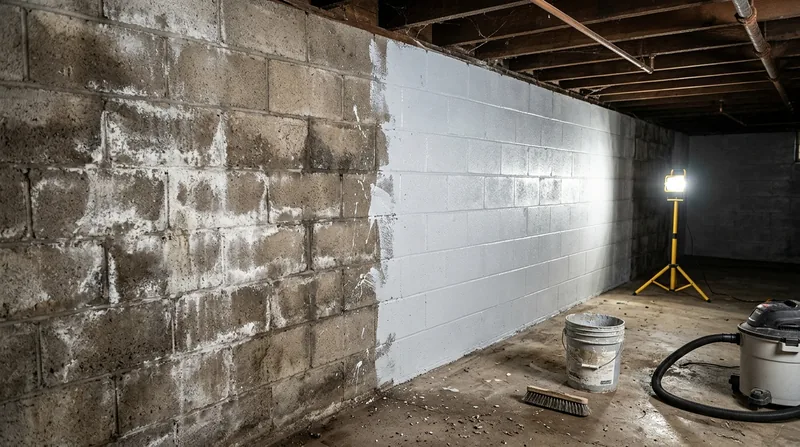




Basement Wall Sealing in Appleton
Appleton sits on the bed of ancient glacial Lake Oshkosh, and that red lake-bed clay under your footing drains about as well as a ceramic dinner plate. When the spring melt off the Fox River flats hits, or a July thunderstorm dumps two inches in an hour, that clay swells, the water table climbs, and the damp finds the weakest point in your foundation wall. Basement Wall Sealing in Appleton is the part of the job that stops surface seepage, kills efflorescence, and gives a block or poured wall a fighting chance above grade. We are a dedicated below-grade specialist, not a general foundation firm and not a plumber, and we will tell you straight whether a sealer is the right tool or whether you are looking at hydrostatic pressure that needs a drain. Start with a free basement inspection and we will show you what the wall is actually doing.
Why Appleton Basements Leak: Glacial Clay, Frost, and Old Foundations
The housing stock here tells you everything. City Park and the streets near Lawrence University are full of 1870s to 1910s Victorian and Queen Anne homes on limestone and brick foundations that were never parged to modern standards. The Fox River flats and the north and east sides hold 1890s to 1930s paper-mill-era frame homes and bungalows on full basements, and the 1950s to 1970s ranches across town sit on block walls with original weeping tile that is now sixty years old and half silted shut. Add deep frost, a big spring melt, and under oaks, maples, and white pines whose roots work the backfill, and you get the failure modes we see every week:
- White powdery efflorescence blooms on block walls where moisture pushes salts out of the masonry.
- Damp patches and a musty basement smell that get worse after rain and never fully dry out.
- Hairline vertical cracks in poured walls that weep at the bottom during freeze-thaw cycles.
- Peeling paint and spalling mortar on old brick and limestone near the frost line.
Most of these are surface and capillary problems a proper sealer can handle. The ones that are not, we say so on the spot.
Key info: A homeowner in the City Park historic district called us about efflorescence on a 1908 brick foundation. The wall was damp but dry to the touch below the frost line, no water on the floor, no drain needed. We removed the bloom, parged the spalled joints, and applied a breathable masonry sealer. That is the honest scope for that house.
For the code and permit side of any structural work, the City of Appleton building department is the authority, and rules vary by jurisdiction, so verify before you cut. See the City of Appleton official site for inspection and permit contacts.
How We Seal a Basement Wall in Appleton, Step by Step
Sealing is not a spray-and-go job. The wall has to be read first, because a sealer over an active hydrostatic leak traps water in the masonry and makes the problem worse. We start with a moisture check and a look at the drain tile, footing drain, and sump basin, then we prep the surface before anything goes on. Here is the sequence on a typical Appleton block or poured wall:
- We inspect the wall, floor joint, and window wells for the source of the moisture and note any crack that needs foundation crack repair first.
- We wire-brush and scrape loose mortar, old paint, and efflorescence, then wash and let the wall dry to spec.
- We fill spalled joints and honeycombs with hydraulic cement or a parging mix where the masonry is failing.
- We apply the sealer, either a penetrating silane-siloxane for brick and block or a membrane coating for poured concrete, in the coats the product calls for.
- We check the grading and downspout extensions so roof water actually leaves the wall instead of soaking the backfill.
- We walk the basement with you and tell you plainly if the wall needs a drain instead of, or in addition to, a sealer.
If the water is coming up through the floor joint rather than through the wall, the sealer is the wrong answer and we will point you to an interior drain tile system.
Key info: On a 1962 ranch in Grand Chute with a block basement, the wall was dry but the floor joint wept every spring. Sealing the block would have done nothing. We routed that homeowner to interior drain tile and a sump, and sealed the wall above grade only where the block was actually damp. Two different problems, two different fixes.
Sealing Methods We Use and When Each One Fits
Not every wall takes the same product. Brick and limestone need to breathe, poured concrete can take a membrane, and a wall with active pressure needs to be drained before it is sealed. This table is how we sort it in the field:
| Approach | Description | Best for |
|---|---|---|
| Penetrating silane-siloxane sealer | Soaks into the masonry and blocks capillary uptake without trapping vapor. | Brick, block, and limestone on older Appleton homes |
| Membrane coating | A flexible film that bridges hairline cracks and sheds surface water. | Poured concrete walls in Grand Chute and Greenville |
| Parging and hydraulic cement repair | Rebuilds spalled joints and honeycombs before sealing goes on. | Failing mortar and old brick foundations |
| Crack injection before sealing | Epoxy or polyurethane injection through ports to close an active leak. | Weeping vertical cracks in poured walls |
| Drain-first correction | Interior perimeter drain and sump when pressure, not surface damp, is the cause. | Water on the floor after every rain |
We pick the method from the wall, not from a price sheet, and we tell you when the cheapest option is the correct one.
Basement Wall Sealing Cost in Appleton: What to Expect
Most residential wall sealing in Appleton starts at From $1,500 and climbs with square footage, wall condition, and access. A single damp block wall in a Kimberly bungalow is a different number than a full perimeter on a 1990s two-story in Harrison with spalled parging and two cracks to inject first. The factors that move the price:
- Wall area and height, since a full basement perimeter takes more product and more prep than one wall.
- Wall material, because brick and limestone need breathable sealer and more careful prep than poured concrete.
- Condition, since efflorescence removal, parging, and crack injection add labor before sealing starts.
- Access, because a finished basement with stored belongings and tight window wells slows the work.
- Whether a drain is needed, because if hydrostatic pressure is the cause, sealing alone will not fix it.
Get two or three estimates and ask each one what they found on the wall and why they chose their method. The full pricing overview has the detail behind these numbers.
Choosing a Basement Wall Sealing Contractor Near Appleton
Plenty of outfits will spray a sealer on a wet wall and cash the check. A few questions separate the ones who know below-grade work from the ones who do not. Ask whether they are licensed and insured, ask for the certificate, and ask for references from jobs in Appleton, Neenah, or Menasha you can actually call. Ask what they will do if the wall turns out to be under hydrostatic pressure, and listen for whether they name a drain or just sell you more sealer.
Permits matter when the scope grows. Structural foundation repair, egress window cutting, and work that alters drainage or the sanitary connection of a sump discharge commonly require a permit, and thresholds vary by jurisdiction, so confirm with the City of Appleton building department. If your home is in a historic district or under an HOA, check those rules before anyone touches the wall. A BHA member contractor will not flinch at those questions. Reach us through the contact page and we will set up the inspection.
Basement Wall Sealing in Appleton: Pricing Guide
| Service | Price | Details |
|---|---|---|
| Single wall sealing, block or poured | Starting at $1,500 | Includes surface prep, efflorescence removal, and one coat of sealer on a single wall. |
| Full perimeter basement wall sealing | Starting at $2,800 | Covers all four walls with prep and sealer; price rises with wall height and finish condition. |
| Masonry repair and parging before sealing | Starting at $900 | Rebuilds spalled joints and honeycombed block so the sealer has sound masonry to bond to. |
| Crack injection plus sealing | Starting at $650 | Epoxy or polyurethane injection through ports on active cracks before the wall is sealed. |
| Complex or large-scale job | On estimate | Historic brick, limestone, or walls with active pressure need an on-site look before a number. |
| Estimate | Free | Response within 24h at (920) 280-6479, no obligation to book the work. |
Indicative pricing, the exact cost depends on square footage, finish, and site access. Free personalized estimate within 24h at (920) 280-6479.


